Best Cutting Board Sets for Kitchen, Gifts & Laser Engraving
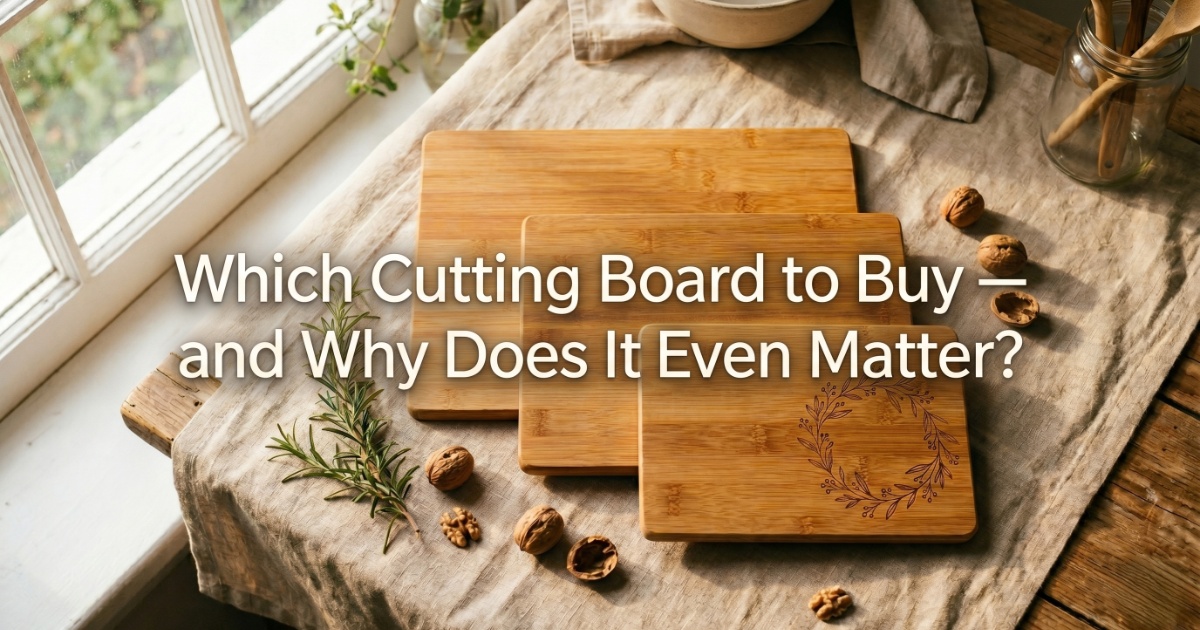
Which Cutting Board to Buy — and Why Does It Even Matter?
Choosing a cutting board sounds simple until you actually start looking. Suddenly there's bamboo, acacia, walnut, maple, plastic, glass — and everyone has an opinion. It's a bit like buying a car: technically any of them will get you from A to B, but once you start driving the right one, you wonder how you managed with the old one for so long.
There are plenty of decent cutting boards out there. But after years of working with wood and watching what actually holds up in a real kitchen — and under a laser — I keep coming back to two sets in particular. One is bamboo. One is acacia. Both are natural, both look genuinely good on a counter, and both behave completely differently once you put a knife — or a laser beam — on them. Here's the honest breakdown.
Royal Craft Wood — Bamboo Set (15×10", 12×8", 9×6")
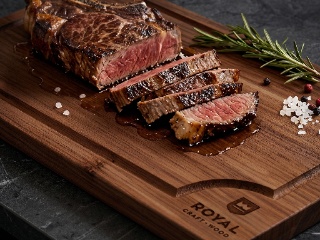
This is the set I'd reach for first. Three sizes, built-in side handles, deep juice groove, and made from carbonized bamboo — which is bamboo that's been heat-treated to increase hardness and moisture resistance. The result is a surface with a Janka hardness rating around 1,380 lbf — harder than most oak, lighter than most hardwood boards of the same size.
Bamboo has a naturally antimicrobial property called bamboo kun — a bio-agent present in the plant's fiber structure that inhibits bacterial growth. That's not marketing language; it's been confirmed in food science research since the early 2000s. Combined with a non-porous, sealed surface, you're looking at a board that's genuinely more hygienic than the average plastic one sitting in most kitchen drawers, which accumulates knife cuts and bacteria in equal measure.
The design is clean and modern — smooth grain, warm color, handles that actually make sense (you can slide the loaded board straight from the counter to the table without spilling). The large 15×10" board doubles as a charcuterie spread at dinner. The small 9×6" lives next to the sink for quick tasks. And the medium covers everything in between. It's a set that's been bought by tens of thousands of people — not because it's the cheapest option, but because it works exactly the way a cutting board should.
Shop Royal Craft Wood Bamboo Set on AmazonMultiple listing photos show all three boards in use — worth browsing before you buy.
Deer & Oak — Acacia Set (pre-oiled, FSC certified)
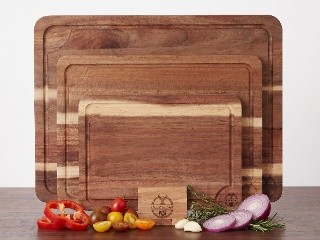
If the bamboo set is the practical daily workhorse, the Deer & Oak acacia set is the one that stops people in their tracks when they see it on the counter. Acacia is a true hardwood — Janka hardness around 2,300 lbf, which puts it in the upper tier of cutting board materials — and its grain is nothing like bamboo's uniform surface. You get deep swirling patterns, natural color variation from golden honey to rich amber-brown, occasional darker streaks. Every board looks slightly different because the tree made it that way.
Acacia also has naturally occurring oils in its grain structure that make it inherently moisture-resistant without heavy processing. The Deer & Oak set comes pre-oiled and FSC-certified — meaning the wood is sourced from responsibly managed forests — and includes a 3.4 fl oz bottle of board oil so you can maintain it from day one. The three boards stack on a stand that keeps them organized and accessible without taking up half your counter.
It's heavier than bamboo, which gives it a substantial feel that some people prefer. Acacia's Janka hardness is at the upper end of what you want for a cutting surface — but here's something most buying guides get wrong: bamboo is actually harder on knife edges than acacia, despite its lower hardness rating. Bamboo contains natural silica particles with a Mohs hardness of 7 — harder than any culinary knife steel — which act as microscopic abrasives on blade edges. Studies show knives dull 20–30% faster on bamboo than on acacia or hardwood. For heavy daily chopping with good knives, acacia or end grain is the smarter choice. For charcuterie, serving, and occasional prep work, either performs beautifully.
Shop Deer & Oak Acacia Set on AmazonThere's a product video on the listing — good to watch before deciding.
Ironwood Gourmet Charleston — End Grain Acacia (14" Square)
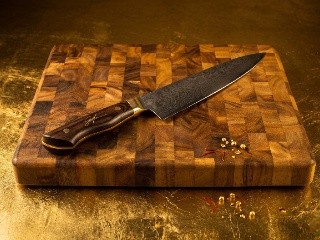
If the previous two sets are about practicality and everyday use, the Ironwood Gourmet Charleston is for the person who wants one board and wants it to be the last one they ever buy. This is a 14" square end grain construction — which means the wood fibers run vertically rather than horizontally. That distinction matters more than most people realize.
End grain boards are self-healing. When a knife blade enters the surface, it parts the wood fibers rather than cutting across them — and when you lift the knife, those fibers close back up. The result is a board that absorbs years of use without the deep visible scarring that ruins most boards over time. It's also significantly gentler on knife edges, which is why serious cooks and professional kitchens almost exclusively use end grain. The Janka hardness of acacia end grain sits around 2,300 lbf, but the vertical fiber orientation distributes the impact instead of resisting it.
The Charleston's surface shows the classic mosaic pattern that end grain produces — alternating wood tones, tight grain lines, a look that's closer to a piece of furniture than a kitchen tool. At 14" square it's large enough for serious prep work and handsome enough to go straight to the table. It comes pre-seasoned with food-safe mineral oil. This is the board you give to someone who cooks seriously — or buy for yourself when you're done compromising.
Shop Ironwood Gourmet Charleston on AmazonThe brand filmed a video showing the board in use — worth watching to see the grain detail up close.
Quick take: Daily kitchen use and laser engraving in volume? Go bamboo — consistent, predictable, knife-friendly. Statement piece or charcuterie board? Go acacia. Buying for a serious cook or a gift that lasts decades? The Ironwood Gourmet end grain is in a different category entirely.
I hope that makes the choice a little easier. Both are genuinely good products — the right one depends on how you're going to use it. But here's the thing: if you have a laser engraver, or you've been thinking about getting one, the story doesn't end at buying a board. It gets a lot more interesting from here.
You Can Engrave This Yourself — And It's Easier Than You Think
A personalized cutting board is one of the most satisfying laser projects you can make. The result looks expensive, takes under 30 minutes, and the person who receives it keeps it for years.
Bamboo and acacia both engrave beautifully with a diode laser. Bamboo is the easier starting point — its grain is uniform and tight, which means the laser does exactly what you tell it across the entire surface. No surprises, no grain pockets that catch the beam differently. You set your power and speed, run your design, and what comes out looks consistent and clean.
Acacia gives you a more dramatic result — the natural grain interacts with the engraving to create a textured, organic look that you genuinely can't replicate on uniform material. The trade-off is variability: two boards from the same batch will look slightly different because the grain is different. For a one-off personalized gift, that variation is beautiful. For a production run, bamboo is the more reliable choice.
The practical setup is straightforward: wipe the board clean, lay masking tape across the surface to catch smoke residue, load your design into LightBurn or xTool Creative Space, and run it. For a 40W diode laser, bamboo engraves cleanly at around 60% power and 3,500 mm/min — but always run a test patch first. Board density varies between batches and brands. On acacia, drop the speed slightly to account for the harder surface.
⚠ Check the finish before you engrave. Some boards come with a high-gloss varnish or wax coating that isn't laser-safe. If the surface has a heavy sheen, test a small corner and check for unusual fumes. Plain, naturally oiled bamboo and acacia are safe. If you're buying boards specifically to engrave, look for unfinished or lightly oiled blanks — they're sold in bulk for exactly this purpose.
For design files, Creative Fabrica has a solid library of cutting board SVG bundles — monograms, family name layouts, botanical patterns, kitchen quotes. Ready to import directly into your laser software. No designing from scratch required.
Wipe off the residue with a dry cloth, then apply a coat of food-grade mineral oil or beeswax finish to the engraved area. It deepens the contrast slightly, seals the burned wood against moisture, and gives the board a finished look that holds up through years of use. Let it absorb for an hour before packaging or giving.
The Profit Is Real — You Don't Need a Factory to Start
Personalized cutting boards are one of the most consistently sold laser products on Etsy. The numbers work, and the barrier to entry is lower than most people think.
Here's the honest math: a quality bamboo blank costs $5–12 depending on size and where you source in bulk. Engraving time per board is 15–30 minutes once your settings and workflow are dialled in. Finished personalized boards sell on Etsy for $45–$85, with larger formats or multi-board sets going higher. After Etsy fees and materials, the margin per board is real — and it scales naturally as your volume increases and your production time drops.
The important thing to understand about starting an Etsy shop for laser products is that you don't need to make a hundred boards before you list. You need two or three finished pieces for product photos, a clear listing with good images, and the ability to fulfil when orders come in. Start with one or two designs — a clean family name layout, a simple monogram, maybe a botanical border — list them, and let the orders come. When they do, you make the board. That's how most successful laser sellers on Etsy actually operate, especially at the start.
What drives sales in this category isn't the cheapest price — it's fast turnaround (under 3 days from order to shipped consistently wins reviews), clean product photography (a board on a real kitchen counter with natural light sells ten times better than a white background), and personalization that feels intentional rather than just slapping a name on wood.
Which size moves fastest? The large board — 15×10" or equivalent — accounts for the majority of personalized cutting board sales on Etsy. It has enough surface area for a design that feels substantial: a family name, a wedding date, a meaningful phrase. Small boards sell as add-ons. If you're starting out, focus on the large format and one or two strong designs before expanding.
Before you price anything, run the numbers. Cutting boards have a higher material cost than ornaments or tags — you need to know your floor price before you list, or you'll sell at a loss without realizing it. Factor in 2026 Etsy fees, materials, and your time.
Frequently Asked Questions
Can you laser engrave bamboo cutting boards?
Yes — bamboo is one of the best materials for laser engraving, especially for beginners. Its tight, uniform grain responds consistently to a diode laser, producing clean and predictable results across the entire surface. A 40W diode laser engraves bamboo well at around 60% power and 3,500 mm/min, though settings vary by laser model and board density. Always run a test patch on a corner before committing to the full design.
Is bamboo or acacia better for laser engraving?
Bamboo is better for production runs. Its uniform grain gives consistent, repeatable results board after board — ideal when you're making multiple identical pieces. Acacia produces a more dramatic, organic result because the natural grain variation interacts with the engraving, but two boards from the same batch will look slightly different. For a one-off personalized gift, that variation is part of the appeal. For volume work, bamboo is the more reliable choice.
Does bamboo dull knives faster than wood cutting boards?
Yes — and this surprises most people. Despite having a lower Janka hardness than acacia, bamboo contains natural silica particles with a Mohs hardness of 7, which is harder than any culinary knife steel. These act as microscopic abrasives on blade edges, dulling knives 20–30% faster than acacia or hardwood boards. If knife longevity matters to you, acacia or an end grain board is the better daily-use choice. Bamboo remains excellent for engraving and gifting — just be aware of the trade-off if it will see heavy kitchen use.
Can I sell laser engraved cutting boards on Etsy?
Yes — personalized cutting boards are consistently among the top-selling laser products on Etsy, particularly as wedding, housewarming, and holiday gifts. A quality bamboo blank costs $5–12 in bulk; finished personalized boards sell for $45–85 or more. Gross margins of 70–85% after materials are common. Demand peaks sharply in Q4, and fast turnaround (under 3 days from order to shipped) is the single biggest driver of positive reviews and repeat customers.